
Any virtual reality experience gives me serious vertigo. My kids still talk about the time I had to cover my eyes on the “Back to the Future” ride at Universal Studios. I also can’t put anything on my face so Google Cardboard was a no go. Anything close to my face panics me; I have to be sedated for a simple teeth cleaning. So, how can I use virtual reality in the classroom when virtual reality pretty much freaks me out?
After reading Minocha’s article on the value of virtual reality in the classroom, I do think it has a place in teaching ELA. Students could visit sites mentioned in texts for a fuller appreciation of setting and environment. Experiential learning cements the lesson more fully in the the student’s memory and adds an element of fun. I downloaded Expeditions on my iPhone and explored the app in AR, that is augmented reality. I learned the while VR replaces my vision by completely covering it (which panics me), AR adds to it. VR allows the user an immersive experience, while AR doesn’t immerse you in an artificial environment, yet allows for a similar experience without headgear. AR I can do, and I could see this easily used in the classroom.
So, I played around in Expeditions in AR. I learned about Pearl Harbor, the lifecycle of bees, and a project I knew nothing about but found fascinating – the One Belt, One Road. This project is designed to create a railway from China to London by way of 64 countries. It is highly ambitious and extremely expensive, but in addition to the commerce objectives, it is thought that it will bring some stability to some of the more fragile countries.
This was one of several AR slides that described the One Belt, One road project. It was easy to move the view around on each slide to see various angles and more of the image. So cool!
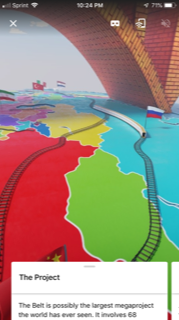
The affordances of AR are ease of use, no need for headgear, and short, instructive “tours”. It can be shown on a smart board in the classroom and all students can view the same images and read the same text. The images that deliniate the text are moveable and able to be viewed at various angles. I really like being able to see the One Belt, One Road rail route with a birds eye view. The constraints are the experience remains at arms length and less immersive. When I consider what could realistically work in a classroom, I think an AR experience is the way to go.
Advice for teachers: I think most young students, grades 6-12, would like using Google Cardboard. The problem is the teacher has no control over content. I can also see Google Cardboard being a cost some families could not fit in their budgets. If the school budget allows for a Google Cardboard for all students, then I think it’s a great learning experience. But, before using VR in the classroom, I think the goals and learning outcomes need to be defined or else it’s just a toy. I also think the teacher needs to be somewhat adept at VR and Google Cardboard.
Questions: Cost aside, can teachers see the value of VR in the class and to what end? Are the simulations instructive and how would you assess VR learning?
 Using Technology for Student Success